
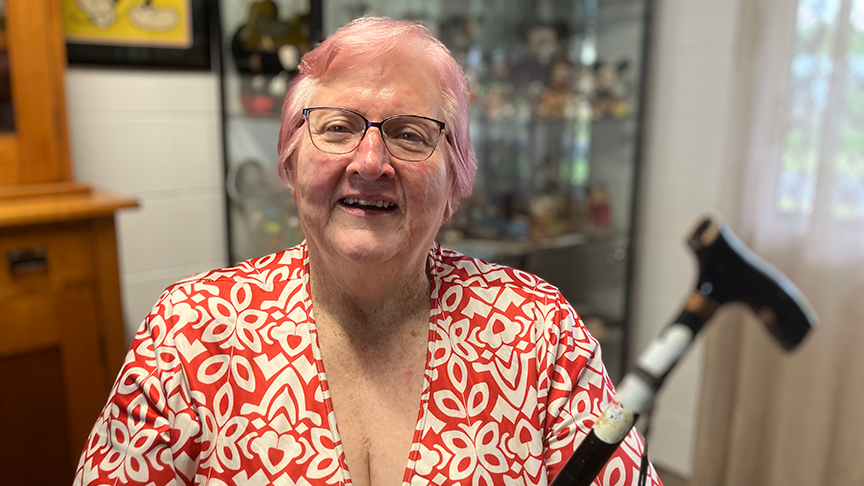
A fall in her home changed Anne’s life – but not her resilience.
It was in the early hours of a day in March last year when Anne – who lived alone – broke her left leg in a fall.
With her phone out of reach, the retired teacher grabbed her walking cane, using it to quickly switch her ensuite light on and off, in SOS morse code, cycling it every five minutes.
‘I knew my neighbours always get up really early – and I’m talking about 3-4 am,’ she said.
‘Combined with my loud teacher’s voice, they saw and heard me as soon as they woke up and came to my rescue immediately.’
The neighbours called Triple Zero (000) for an ambulance crew to rush Anne to Cairns Hospital.
Surgery soon followed to repair Anne’s shattered femur, including steel pins and bar inserted into her leg.
After six weeks of no weight-bearing in Cairns then Babinda hospitals, Anne went to the hospital’s off-campus Sub-Acute Care Unit (SACU) in Manoora.
The 48-bed ward, located next door to the Infinite Care facility on Oregon St, provides care for older people and those requiring rehabilitation.
After successful rehabilitation Anne returned home, which during her absence had been transformed as friends had pitched in to modify her bathroom into what Anne describes as an ‘occupational therapist’s dream for safety.’
After a short stint back at home, complications arose. Anne faced a setback with a severe leg infection. She started suffering excruciating pain in both legs.
She was later diagnosed with sepsis - a life-threatening condition that arises when the body's response to an infection damages its own tissues and organs, resulting in a longer stay in Cairns Hospital. Multiple surgeries scrubbed out dead bone, replaced steel, and filled gaps with antibiotic-laced cement.
At one stage, the infection was so bad, Anne faced a potential leg amputation.
Fortunately, once she became well enough, she was eventually shifted back to SACU, both legs intact. This was followed by yet another surgery to clean out the infection and a third stay at SACU to undergo more rehabilitation to gain back mobility and independence.
Whilst at SACU, Anne received treatment from a multidisciplinary team of doctors, nurses, and allied health workers.
Anne had high praise for the SACU team, whom she said treated her more like a family member, rather than a patient.
She even bonded with one staff member over a shared obsession with all things Mickey Mouse, comparing the dozens of items they had in their extensive collections back home.
‘It feels far more like a home than a hospital. It’s nice to be able to look out a window and see a garden,’ Anne said.
With the assistance of the SACU rehabilitation team, Anne has returned home once again, where she is well on the road to recovery, albeit still having to attend outpatient appointments for her condition and facing further surgery.
‘You have to be optimistic and stay positive about your situation knowing that you will be back home one day,’ she said.
SACU occupational therapist Jennifer Baillie was part of the team that had the pleasure of assisting Anne with her rehabilitation, facilitating her goals to return home.
Ms Baillie described Anne as a determined patient.
‘Our service continues to be patient-focussed to provide a holistic approach to patient care from our medical, nursing, support services, and allied health staff,’ she said.
‘Annie is one of our many success stories.
‘Our service is proud that we have a minimal number of patient readmissions to hospital once discharged, and that most patients return to their usual residence.’
She said Anne’s story was a testament to the patient and her team, including occupational therapist Stacey Marais, who worked with Anne all three times she visited SACU.
‘And yes, our occupational therapist is still dreaming about that new bathroom,’ she said.
Tips for falls prevention in the home
Most falls occur in and around the home.
Most falls occur in the bedroom, garden and living or family areas because of tripping or slipping due to lighting and structural hazards.
While health and lifestyle issues are important to reduce your risk of falling, it is also important to minimise any risk factors in your everyday surroundings.
For a checklist of things you can do to prevent falls in the home, see the Queensland Government's tips to reduce falls at home.