
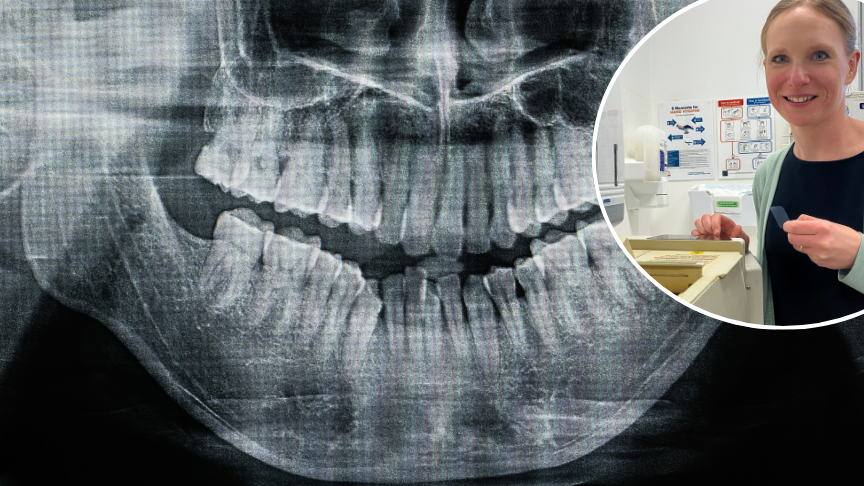
Rural dental patients will be able to receive faster diagnoses and improved access to care through a digitisation of oral health imaging services across the Far North.
Cairns and Hinterland Hospital and Health Service (CHHHS) is transitioning its oral health services from analogue X-rays to digital imaging to deliver safer, more efficient care and better outcomes for rural and remote patients.
Dentists use X-rays to diagnose and monitor dental issues such as cavities, infections, bone loss, and impacted teeth that are not visible during a regular oral examination.
For decades, analogue X-rays required exposing film to radiation and then chemically processing it to produce a physical image.
These analogue systems are still used in some regional and rural clinics due to limited connectivity in remote areas.
CHHHS Oral Health director Dr Herholdt ‘Harry’ Robertson said the $300,000 digitisation project has overcome significant geographical and technical challenges across one of Queensland’s largest and most dispersed health service areas.
‘Digital imaging has been available for some time but implementing it across our multi-site service has been complex due to our geography, remote locations and connectivity black spots,’ Dr Robertson said.
‘We’ve taken a staged approach, starting with our larger hubs such as Mareeba Hospital and progressively expanding to smaller clinics and school dental services, including locations such as Mossman, Yarrabah and Georgetown.’
Dr Robertson said the digitisation project would provide dentists with instant access to images across multiple connected sites.
‘If an X-Ray is taken in Georgetown, it can be viewed on the same day by a specialist in Cairns or another location without needing to physically transfer the film,’ he said.
‘This reduces the need for repeat X-rays, which is better for patient safety and convenience.
‘The digital imaging integrates with our hospital’s medical imaging software and technology, simplifying workflows and enabling faster diagnosis and treatment, especially in emergencies.
‘Being able to store and access images within the hospital’s medical imaging system makes it easier for our teams to collaborate and provide timely care.’
Dr Robertson said the project also eliminated the need for in-house chemical processing.
‘With analogue X-rays, we needed to use chemicals like fixer and developer, which are hazardous and require special storage and disposal,’ he said.
‘Digital imaging eliminates this entirely, improving safety and reducing our environmental impact.’
The rollout of digital imaging software across all of CHHHS’ dental facilities is expected to be completed by the end of 2026.
The oral health rollout is the first implementation under the broader Medical Imaging Information System project.
This project will replace the health service's ageing medical imaging systems, improving reliability, supportability and access to imaging information across CHHHS.