
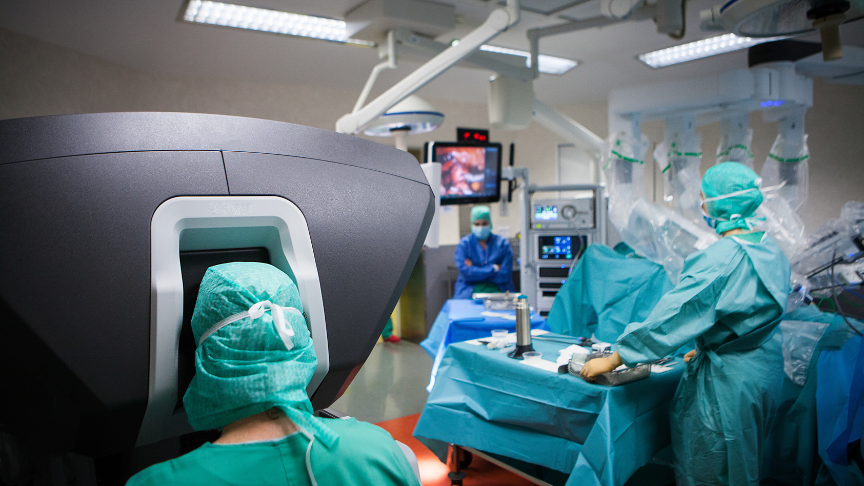
Cairns Hospital is advancing public healthcare in Far North Queensland with cutting-edge robotic and artificial intelligence (AI) technology.
A new $4.3 million surgical robot, fully funded by the Far North Queensland Hospital Foundation, is expected to be operational at the hospital by the end of 2026.
The high-tech robot will initially focus on urology procedures, particularly prostate cancer surgeries, which are in high demand in the region.
Cairns and Hinterland Hospital and Health Service Chief Executive Leena Singh said the robot would then be shifted into its new home within the Health Innovation and Surgical Centre, when it is expected to open in 2031.
The new centre will house four theatres, a 32-bed ward, and outpatient facilities.
‘Our new surgical robot will allow surgeons to perform complex procedures with unparalleled precision,’ Ms Singh said.
‘The robot will initially focus on urology procedures, particularly prostate cancer surgeries.
‘Currently, an average of 253 men are diagnosed with prostate cancer each year in FNQ, and we are projecting a 40 per cent increase in cases among men over 70 within the next four years.’
She said to address the projected rise in prostate cancer surgeries, the health service was developing a comprehensive prostate cancer pathway to ensure timely diagnosis, treatment, and follow-up care.
‘With the robot, we will be able to perform up to 200 urological procedures annually, compared to the 50 we currently outsource,’ she said.
‘This will make a significant difference for patients and their families.’
CHHHS Director of Intensive Care, Women’s and Perioperative Services, Deborah Clark said the health service was also investing in AI to advance other specialities, such as ophthalmology.
‘We are in the process of procuring a phacoemulsification machine for cataract surgery,’ she said.
‘This AI-powered device uses real-time algorithms to enhance surgical precision, maintain stable eye pressure, and optimise outcomes.
‘It will allow us to treat more patients efficiently and improve their quality of life.’
She said in addition to improving patient care, the new technology would provide invaluable training opportunities for clinicians.
‘Integrating robotics and AI into our medical education and research, will ensure the next generation of healthcare professionals are equipped with the skills to deliver world class care,’ she said.