
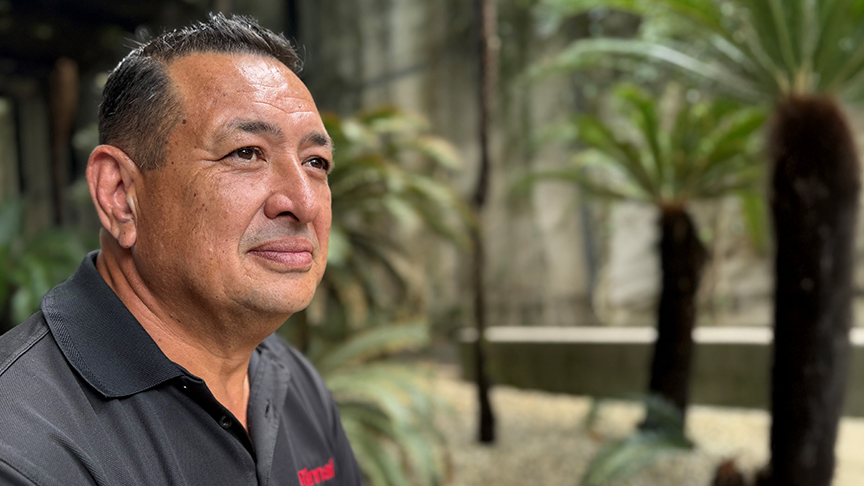
It started with symptoms akin to a simple flu: fever, sweats, and shivers.
When he started feeling especially sick, Bayview Heights resident Chuck Irvine - who prides himself on his health and fitness - went straight to his GP, got blood tests, and was told to rest.
But over the next three weeks, things worsened for the 53-year-old, dramatically.
‘I just kept getting worse, so I went back in for another visit with my GP and more tests,’ Chuck said.
‘Once my doctor received those results, he rang me up and told me to go straight to the Emergency Department.’
By the time a friend rushed him to Cairns Hospital, Chuck’s temperature had spiked to nearly 41C, leaving him delirious and hallucinating.
Doctors diagnosed him with the tropical disease known as melioidosis, finding the dangerous soil-borne bacterium Burkholderia pseudomallei had infected his lungs, hip bone, and an artery leading to his right leg.
Emergency surgery followed, involving a large abdominal incision and an artificial artery graft rerouted from Chuck’s left side of his body.
Chuck spent 10 days in hospital, followed by months of recovery, weight loss, muscle wasting, and ongoing antibiotics.
‘It was terrifying, painful and very scary,’ he said.
‘I went from thinking I had a flu, that I would normally recover from in a week, to nearly dying.
‘I’ve never had a serious illness like this, in more than 30 years of living in Cairns.’
Chuck was unfortunately one of nearly 130 people diagnosed with melioidosis during the 2025 wet season in Cairns. Sadly 17 of these people died from the illness.
Most of these cases occurred in Cairns’ southern suburbs, including Bayview Heights where Chuck lives.
The disease is particularly dangerous for those with underlying health conditions including diabetes, chronic kidney/lung disease, heavy alcohol use, and other conditions that weaken the body’s immune system.
Chuck later found out that he was a borderline Type 2 diabetic, which may have made him more susceptible to the illness.
However, it is unknown how he became infected by the soil-borne bacteria, that can enter the body through cuts, abrasions, and droplets in the air.
He suspects his new puppy digging up the yard may have indirectly exposed him, possibly via a tiny unnoticed scratch or hand-to-mouth contact, despite no visible cuts and his largely indoor lifestyle.
Despite this, Chuck’s message to Far North Queenslanders is clear:
‘Don’t wait,’ he said.
‘If you are showing symptoms, get to your GP or hospital sooner than later.
‘I probably left it too long. I thought it was just flu, and it worsened on me.’
With the wet season well and truly arrived in the Far North, clinicians are hoping to educate people about the dangers of melioidosis, which they have rebranded ‘melio’ to make it easier to remember.
Cairns Public Health Unit director, Dr Jacqueline Murdoch, said the shortened name ‘melio’ was chosen after community feedback showed the full name ‘melioidosis’ was hard to pronounce.
‘Melio’ is short, sharp and unmistakably local,’ Dr Murdoch said.
Dr Murdoch said early research continued to show a clear spike in melioidosis cases in Cairns during periods of very heavy rainfall.
‘People with diabetes, kidney disease, lung conditions or anyone on treatment that lowers their immune system - such as chemotherapy or long-term steroids - are most at risk from melio,’ she said.
‘Healthy people under 50 with no underlying conditions are at very low risk.’
She said the Big Wet stirred melio up from deep in the soil and brought it to the surface.
‘That’s why we’re asking people with chronic health conditions, to take three simple steps:
- Look after your underlying health – make sure you are managing your chronic disease with your GP.
- Cover open cuts, wear waterproof shoes outdoors, avoid muddy water and wash hands well.
- Stay indoors during very heavy rain if you’re in a high-risk group.
‘If you’re immunosuppressed and suddenly get a fever, cough or feel really unwell after heavy rain, get medical help straight away and tell them you’re worried about melio,’ Dr Murdoch said.
Symptoms of acute melio can include high fever, cough, chest pain and shortness of breath.
It can rapidly become severe and usually requires weeks of strong antibiotics in hospital.
Sometimes it shows up as skin infections, boils or abscesses that don’t heal.
‘If you have a wound that won’t heal or ongoing fever for weeks after the wet season starts, see your GP and mention possible melio exposure,’ Dr Murdoch said.
You can learn more about melioidosis (Melio) by calling 13 HEALTH (13 43 25 84) or visiting https://www.qld.gov.au/health/condition/infections-and-parasites/bacterial-infections/melioidosis