
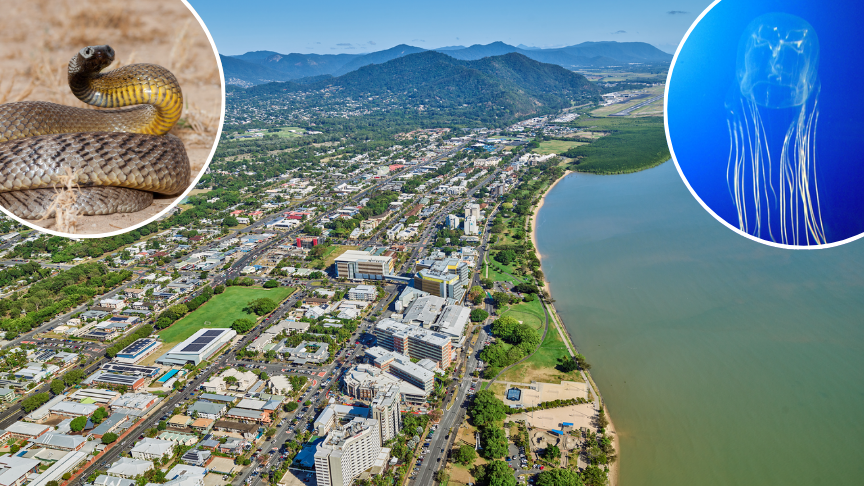
Cairns will become a world leader in venom-treating under an exciting plan to upgrade Cairns Hospital’s toxicology unit.
A Toxicology Centre of Excellence is a core component of the new Cairns Hospital Health Innovation and Surgical Centre, under the hospital’s $1 billion expansion.
The new centre - to be housed inside the new building, will include a dedicated research laboratory, education facilities, and new offices.
Cairns and Hinterland Hospital and Health Service chief executive Leena Singh said the toxicology unit had built a reputation that extended well beyond the Far North.
‘A formal centre of excellence will consolidate that asset into a structure capable of driving research, attracting funding, and producing the kind of evidence that shapes clinical practice nationally and internationally,’ Ms Singh said.
‘Australia is home to some of the world's most medically significant venomous species, and Cairns sits in the middle of some of the highest-exposure geography in the country.
‘Systematic research into envenomation management, antivenom use and patient outcomes has the potential to redefine treatment protocols across the Asia-Pacific region and beyond.’
Local emergency departments regularly treat patients for bites and stings from unique fauna such as box jellyfish – known as the most venomous animal on the planet, Irukandji jellyfish, taipans, eastern brown snakes, stonefish, stingrays, bees, wasps, and redback spiders.
They also manage patients being envenomated from stings from the Far North’s infamous Gympie-Gympie stinging tree.
Beyond envenomation, the centre will also address substance toxicity, pharmaceutical overdose, and the complex intersections between mental health, chronic disease and poisoning presentations that characterise a significant proportion of the emergency caseload not only in regional and remote Queensland but in the broader Pacific region.
Cairns Hospital toxicologist Dr Digby Green said the mix of patient cases he and his colleagues managed was ‘extraordinary.’
‘We have patients presenting with conditions that the rest of the world wants to understand better,’ Dr Green said.
‘The opportunity to turn that clinical experience into rigorous research, and to have that research actually change how patients are treated, is exactly why a centre like this matters.’
He said a recognised centre of excellence would create a destination for toxicology training, drawing clinicians from worldwide to live and work in Far North Queensland.
‘We want Cairns to be the place people come to learn toxicology in a tropical context,’ he said.
‘There is no other place on Earth that can offer what we can offer.’