
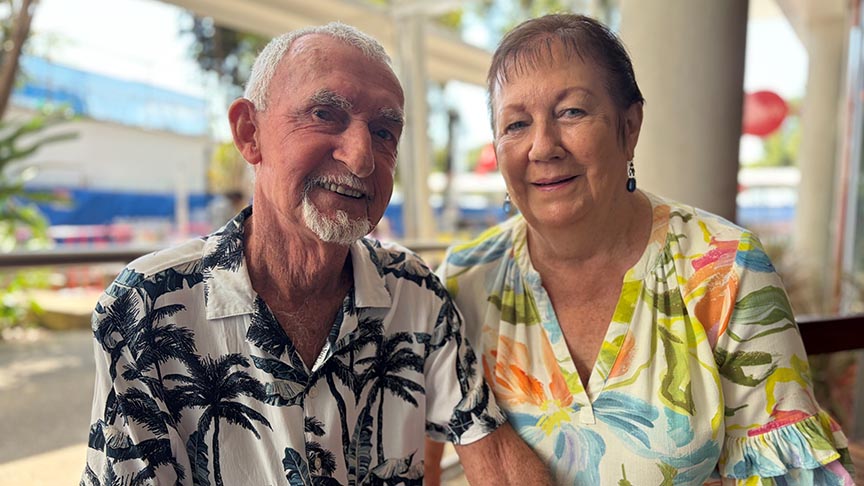
For renowned local author Robert Reid words have been his life, so losing the ability to use them has been tough.
The crime writer, who has had nine books published on notorious events around Far North Queensland, sadly suffered a stroke at his Caravonica home in early June.
Thanks to the quick thinking of his wife of 29 years Cheryl and quick actions of paramedics, Cairns Hospital clinicians were able to administer vital medication which reduced the severity of the stroke.
But the 86-year-old faces a long recovery journey, spending eight weeks in the hospital’s Stroke Unit and the Sub-Acute Care Unit learning, and is still trying to fully regain his speaking ability.
‘As someone who lived with words, I can’t even say what I’m thinking,’ he said.
‘I was in denial, but Cheryl has helped me through it immensely.’
Cheryl remembers 1 June vividly. Coming in from the garden she found Robert standing in the lounge room looking confused and unable to speak.
‘I had no knowledge of a stroke ever before, I’d never even known anyone who’d had one before,’ she said.
‘But I knew when he couldn’t speak that something was very wrong straight away.’
After arriving at Cairns Hospital’s Emergency Department, he was able to be treated with thrombolysis and was admitted to the Acute Stroke Unit.
Thrombolysis is a drug given to stroke patients which is able to dissolve brain blood clots and should be administered as soon as possible to get the maximum benefit.
Robert was able to be treated within around 90 minutes.
His case is a prime example of why the hospital’s Stroke Unit has recently been recognised for its high-quality patient care, winning a Gold Status Award through the World Stroke Organisation.
Cairns Hospital treats around 360 acute strokes each year and the award is linked to delivering timely and appropriate patient care.
Cairns Hospital Senior Staff Specialist in Stroke Medicine and Geriatrics, Dr Ramesh Durairaj said achieving WSO Gold Status was a testament to a team effort to enhance stroke care in the region.
‘Stroke is a time-critical medical emergency where blood supply to the brain is interrupted or reduced,’ Dr Durairaj said.
‘With each minute that goes by, more brain cells can be lost, and the risk of disability and death increases.
‘Acting swiftly on the signs of stroke and implementing best practice care requires coordination between ambulance, emergency department, radiology, and stroke unit staff.’
Robert and Cheryl said the care from the hospital had been impeccable, also highlighting the Hospital in the Home care Robert received when he was able to return home.
‘It was wonderful, a nurse came every single day and did his blood pressure, temperature and heart rate and that put my mind at ease that they were ok,’ Cheryl said.
‘All the staff have been just wonderful.’