
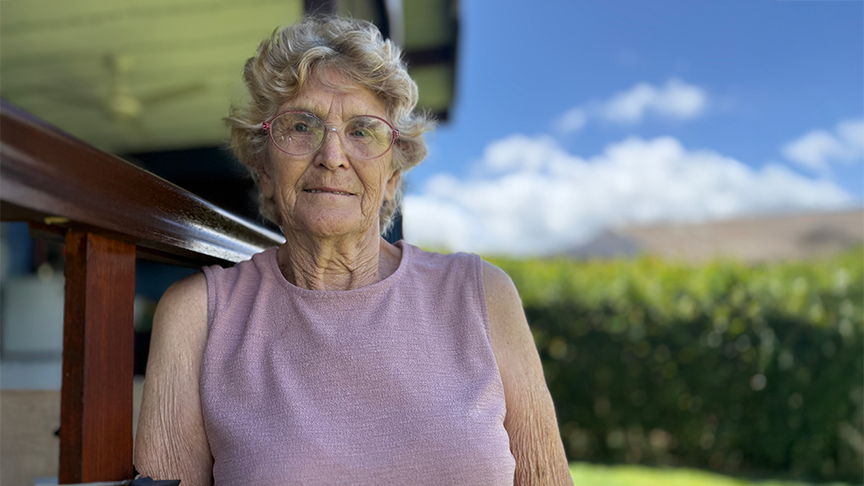
Carol Miller never believed a trial of a little pill could make such a big difference to her life.
For nearly seven decades, the spritely 81-year-old had lung issues casting a shadow over her vibrant spirit.
Diagnosed initially with asthma and bronchiectasis at age 14, Carol estimates she spent six weeks in hospital every year from 1986 through to 1999, battling relentless chest infections and coughing fits that left her breathless and bedridden for months.
‘I’d get so sick, my chest would fill with thick, brown mucus, and certain smells like perfumes or ammonia from cleaning would set me off, instantly,’ she said.
Living near Mt Garnet, two hours west of Cairns, Carol made the trek to Brisbane twice a year to see specialists.
However, the mother of six reached a major turning point in June 2023, shortly after losing her husband to illness, when she was invited to participate in an international clinical trial through Cairns Hospital.
The ASPEN clinical trial by US based biopharmaceutical company Insmed was a major international study involving an oral drug brensocatib, to see if it could safely cut down lung flare-ups and slow breathing problems in patients with bronchiectasis.
Hesitant at first, Carol consulted her children about the clinical trial, concerned it may interfere with her visiting her grandchildren, all scattered around the country.
'No Mum, it’ll fit right in’, they told me', she said.
‘They assured me, too, that I could quit the trial at any point, so I agreed to be signed up.’
Under the care of Cairns Hospital’s respiratory team, including Dr James Brown and clinical trial coordinator Sussan Conway, Carol started a once-daily tablet alongside a puffer and long-term antibiotic.
Two years later, Carol, now living in Gordonvale, described the results as transformative.
‘I’ve gone from just one chest infection in two years,’ she said.
‘I’m not coughing nearly as much, and when I do get sick, the mucus isn’t watery or brown anymore.’
She said her specialist visits had dropped from twice to once a year, and lung function tests hit an all-time high of 48 per cent.
After stopping her usual long 6km walks during her husband’s illness, Carol now strolls a leisurely 1km daily with one of her sons and their dogs.
‘I’ve always been active. It annoyed me not to be. Now I’m getting there again,’ she said.
Cairns Hospital respiratory physician Dr Stephen Vincent described Carol’s bronchiectasis as a debilitating lung condition.
‘The airways become permanently dilated and damaged, which results in the build-up of mucous,’ Dr Vincent said.
‘Symptoms of chronic cough and breathlessness occur on a daily basis, and patients can deteriorate when the airways become infected with a virus or bacteria requiring long courses of antibiotics.’
He said when the disease is severe, sufferers are not able to perform their activities of daily living and require support from family members for assistance.
‘Unfortunately, there has not been any effective treatments available for a number of years,’ he said.
‘With the introduction of brensocatib - a novel medication which reduces inflammation of the airways - there now exists an effective treatment approach which reduces the degree of airway destruction and the rates of exacerbations.
‘Overall, the quality of life of people with bronchiectasis will improve with this medication.’
Carol said she was thankful she had the opportunity to be involved in the clinical trial, one of nearly 70 trials for a variety of health studies currently underway across the Cairns and Hinterland Hospital and Health Service.
‘I feel like medical science has given me my life back,’ she said.
Read more information about Cairns and Hinterland Hospital and Health Service's research and clinical trials.