
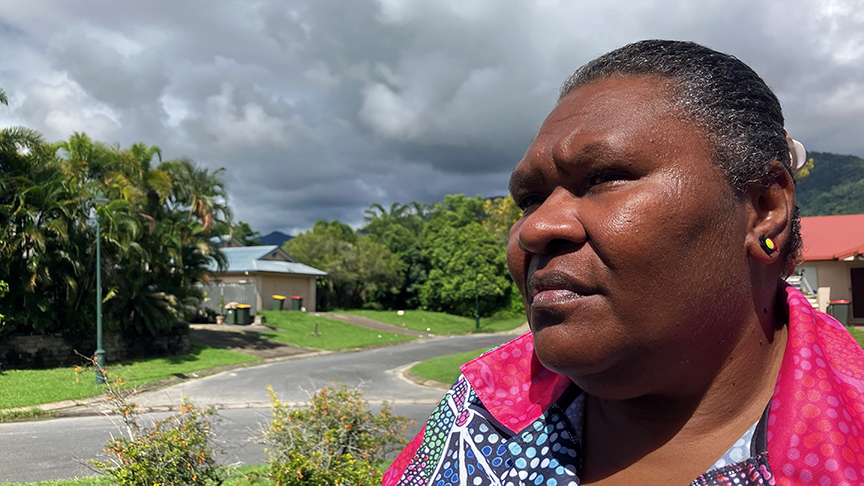
A simple act of pulling weeds from her driveway may have led to a Cairns woman being hospitalised for a month after being struck down by a dangerous tropical illness.
Leichan Williams, 50, was one of the more than 130 people infected with melioidosis during the Cairns region’s worst ever outbreak of the disease in early-2025.
Melioidosis – known locally as melio – is a bacteria that lives in soil and muddy water.
It can enter the body through cuts and abrasions or be inhaled in tiny water droplets during heavy rain.
Prior to her infection, Leichan, who lives with her husband and two children in the southside suburb of White Rock, had only ever heard about melio through her work at a local childcare centre.
She believed she may have been infected with the melio bacteria at home, carrying out some impromptu gardening after returning home one day.
‘I came home from work, jumped out of the car and went to clean the grass and debris out of the drain near our driveway,’ she said.
‘We’ve got four cars, so I didn’t want the drain to block because it was really heavy rain.
‘I wasn’t wearing much protection, just quickly doing it. I reckon that’s how it started.
‘I must have had a small cut somewhere, maybe on my hand or head.
‘Nothing big or obvious, but something small.
‘Being 50, diabetic and with high blood pressure, I fitted all the risk categories.’
Those over the age of 50, particularly those with chronic health conditions such as diabetes, kidney disease, chronic lung conditions, or weakened immune systems are particularly at risk from melio.
Symptoms may include fever, cough and difficulty breathing as a sign of a lung infection ('pneumonia').
Leichan said her first symptom manifested itself in the form of extreme fatigue.
‘I was getting tiredness, but not normal tiredness from work,’ she said.
‘This was tiredness for no reason. I was getting enough sleep. My sugar levels were good, so I knew it wasn’t my diabetes. But I’ve come home after only five hours of work and be absolutely exhausted.’
Leichan then lost her appetite, and struggled to keep food down. She then started to feel pains in her chest and back.
‘I sought medical help straight away, as soon as the tiredness and weight loss started,’ she said.
‘I lost 11kg in three weeks – and you can’t do that with diet and exercise alone.
‘My workmates were telling me I looked different, my clothes were loose, and something wasn’t right.’
Leichan attended Cairns Hospital’s Emergency Department, about a week after her first visit to her GP, as her body and right leg throbbed with pain.
Doctors diagnosed her with sepsis – an extreme reaction to the melio bacterial infection raging through her body. Her right knee had become severely inflamed from the infection.
Once the melio bacteria invades the body, it causes infection by creating abscesses (collections of pus) in organs, leading to pneumonia, sepsis or localised infections.
‘My knee was huge – it looked like a polished coconut. I couldn’t put any weight on it,’ Leichan said.
‘They drained it straight away – two bottles of fluid came out.
‘Then my temperature kept rising, up to nearly 39–40C.
‘They drained it again that night. Then two days later they had to do it again because my temperature still wouldn’t come down.
Doctors performed surgery on Leichan’s knee, twice – each time flushing out approximately 8L of fluid. They also needed to scrape away about 20cm of her femur bone to remove the bacterial infection.
‘The infection was in patches – my leg, my back, and later my heart. I also developed a blood clot. My blood pressure kept dropping under 100. I was very unwell,’ Leichan said.
Luckily, a strong course of antibiotics helped Leichan’s body fight the infection, and ultimately helped save her leg from amputation.
‘At one point, the doctors were considering ICU,’ she said.
‘The infection could have cost me my leg.
‘I went from 120kg to 94kg by the time I left the hospital.’
Twelve months after her hospitalisation, Leichan has returned to work, but still finds it challenging to walk up stairs and get in and out of vehicles, while her leg heals from surgery, and her body returns to normal.
She says doctors will monitor her for the next three years, as she is high risk for re-infection.
‘Melioidosis isn’t going anywhere. It’s always in the soil,’ she said.
‘If you have diabetes, high blood pressure, or other conditions, you’re more vulnerable.
‘Don’t garden after heavy rain. Wear personal protective equipment: gloves, boots, even masks if needed.
‘You wouldn’t ride a motorbike in thongs – this is the same thing.
‘Melio is not something to play with. It’s worse than your worst enemy.’
If you have an existing health condition and you suddenly get unwell, ring 13 HEALTH (13 43 25 84) urgently for advice.
You can learn more about melioidosis (Melio) by calling 13 HEALTH (13 43 25 84) or visit Queensland Government's health conditions directory on Melioidosis.