
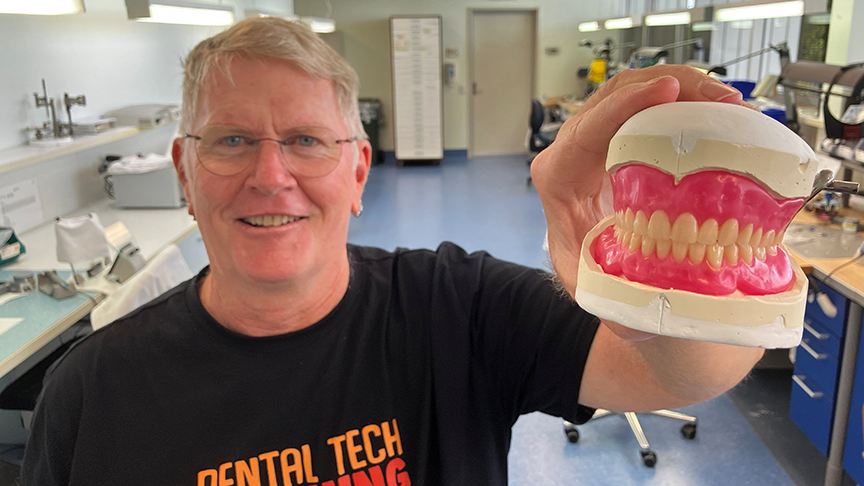
When David Sims started crafting dentures for patients in the late-70s, it was entirely by hand and using acrylic.
Nearly 50 years later, dentures are designed on computer and manufactured with high-tech materials, rendered by 3D printer.
The one thing that hasn’t changed in five decades, though, is the fundamental artistry involved-the human touch and skill required to create a natural-looking, life-changing smile that truly fits the individual.
‘Sometimes we get to see the impact of our work: putting a life-changing smile on somebody’s face,’ David said.
‘That’s pretty amazing. I’d like to say we’re helping people achieve their smile goals.’
Working out of the dental lab at Cairns North Community Health Centre, David is one of a handful of advanced dental technicians, nationwide, specialised in designing and manufacturing dentures.
Dentures are false teeth that have been custom-made to fit a person’s mouth.
A full or complete denture replaces all a person’s natural teeth, and a partial denture rests on an acrylic or metal framework that attaches or clips to some remaining natural teeth.
It takes a high degree of precision and skill in order to design and manufacture dentures to fit individual people.
‘Most people don’t know the job exists,’ David said.
Back in 1979, when David began as what many still called a ‘dental mechanic,’ the process relied on manual impressions, wax setups, and painstaking hand-carving of teeth arrangements.
Materials like vulcanite (the hardened rubber of the era) had given way to acrylics, but the technician's eye for detail, sense of aesthetics, and understanding of facial harmony were everything.
‘More art than science,’ David said, recalling how he'd tint and characterise a single tooth to make it blend seamlessly with a patient's existing ones - so perfectly that no one could tell which was the replacement.
In the digital era, David’s main tools are software programs for 3D rendering of clients’ mouths, and 3D printers, which bring the dentures to life in durable polymethacrylate – a type of acrylic glass.
David estimates that within the past two years, the team has produced approximately 2000 items of dental prosthetics, ranging from single teeth through to full denture sets.
While he misses some of the hands-on work of yesteryear, David said he wouldn’t trade it for the current technology he uses daily.
‘It’s great,’ he said.
‘If I was 20 years younger, I’d dive right in and enjoy where the technology is heading.’