
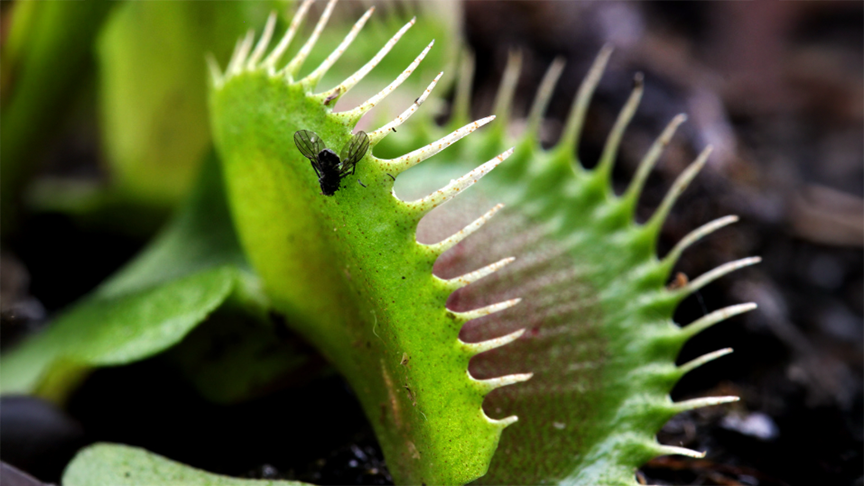
Just as a healthy fly is lured to its doom inside the carnivorous jaws of a Venus flytrap, healthy breast cells are inexplicably lured into cancerous breast cells, where they are destroyed - ultimately making the cancer stronger.
This process — known as entosis — is the focus of ground-breaking research by Ellen Janke, a pharmacist at Cairns Hospital’s Emergency Department, whose University of Queensland PhD research could unlock new ways to fight aggressive breast cancers.
Breast cancer is the most common cancer for Australian women.
In Queensland, one in every 10 women will develop breast cancer by the age of 75 years.
Dr Janke’s research explores how calcium — a key messenger inside cells — behaves differently in the healthy and cancerous cells during entosis.
She has developed a method to observe these calcium signals in real time, using normal breast cells and cancerous breast cancer cells.
‘We’re trying to understand why a healthy breast cell would enter a cancer cell and die, making the cancer stronger,’ Dr Janke said.
‘It’s like a fly willingly landing in a Venus flytrap.
‘By studying how calcium signals differ between these cells, we’re learning more about how this process works.’
Dr Janke used fluorescent sensors — green for healthy cells and red for cancer cells — to watch the cells interact.
Her findings show that calcium signals act differently in the healthy cell trapped inside the cancer cell compared to the cancer cell itself.
This discovery could help scientists find ways to stop entosis and improve outcomes for patients with aggressive breast cancers.
‘For this research, I’m using equipment already common in drug companies,’ Ms Janke said.
‘This means we could use this approach to test new drugs that might block this process, offering hope for better treatments for advanced breast cancer.’
She said there was still more to find out about the way cancer cells interact with healthy cells within the human body.
‘Entosis is just one of many different forms of cell death, but it’s really interesting because it’s a process that seems to be driven by the cell that benefits the least from the process,’ she said.
‘In order to better understand how to treat forms of breast cancer, we need to better understand it.
‘Hopefully my research is helping advance that cause.’