
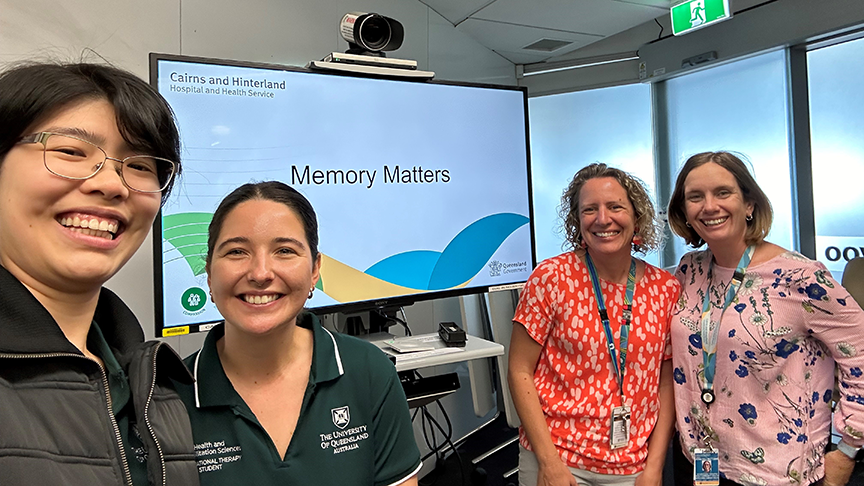
A dedicated team of clinicians is giving patients an ‘unforgettable’ experience in learning to live well with cognitive impairment.
The Memory Matters group is an alternate way of delivering occupational therapy services from Cairns North Community Health Centre. This service is making a difference is making a difference to the lives of patients living with conditions such as dementia, delirium, neurological conditions, and acquired brain injuries.
The program was developed two years ago by occupational therapists (OT) Leona Hall-Matthews and Mel Smith, who identified a need for providing rehabilitation for patients living with low-moderate levels of cognitive decline.
The program is run by occupational therapy students on placement with the health service, overseen by the experienced OTs.
Ms Hall-Matthews said group programs were regarded as the gold standard for supporting patients with cognitive impairment.
‘The research is telling us that group therapy works a lot better for people, than individual therapies,’ she said.
‘People like to know that actually their experiences are shared, and they get a lot out of the social element.
‘It’s also an efficient way of delivering our service, whilst providing valuable learning experiences for occupational therapy students who are involved in running the group.’
Program participants are taught strategies to support their memory, enabling them to become more independent.
Ms Hall-Matthews said this included external strategies such as using dairies, calendars, smartphones, lists, and medication packs; and internal strategies such as mental visualisation, association, repetition, and ‘chunking.’
‘If you think of a phone number, the best way to remember it is to break it down into breaks in the numbers,’ she said.
‘So, for example, a hospital number would be 07, 4-22, then whatever the extension number is.
‘Breaking down the number into smaller sequences is easier to remember.
‘You can apply this strategy to other things like shopping lists, calendar dates, or even sentences to help you remember.’
Ms Smith said smartphone technology was particularly helpful for those living with cognitive impairment.
‘For some people, one of the most important things they learn is setting alarms using voice-controlled virtual assistants such as Siri,’ she said.
‘Something as simple as asking Siri to set an alarm 15 minutes from now, can help you remember to turn off the water for the hose in the garden, and similar activities.’
Ms Smith said in the two years the program had been in operation, it had helped significantly reduce the waiting time for cognitive rehab services.
‘The client feedback we’ve received about the service has been overwhelmingly positive,’ she said.
‘We’ve had reports that the program has helped many participants retrain their memory, and given them the opportunity to build social connections with others.’
Top mental tips for improving your memory
- Memory imagery/visualisation: forming a strong mental image to assist with learning and recall. Visualise or rehearse activities in your mind. Break each step down and imaging how you would do it in real life.
- Association: relate what you want to learn with something you already know. Form a link between visual information and verbal information, or new information with prior knowledge
- Categorisation/chunking: grouping separate information together based on similarities.
- Repetition: trying to learn something by repeating it over and over
- Repetition: trying to learn something by repeating it over and over